The current economy has sparked countless conversations about jobs, inflation and artificial intelligence. I think there’s another conversation worth having.
According to the Wall Street Journal‘s analysis of federal labor data, nearly two million Americans have been unemployed for six months or longer. Meanwhile, companies including Amazon, Meta, Microsoft, UPS, Verizon, Walmart and Disney have announced layoffs as they restructure and invest more heavily in artificial intelligence, making an already difficult job market even harder to navigate.
Most of the conversation has focused on what these changes mean for the economy. We ask how many jobs were lost, which industries are hiring and whether artificial intelligence will reshape the workforce.
Those questions matter, but I think they’re causing us to overlook another kind of loss, one that’s much harder to measure.
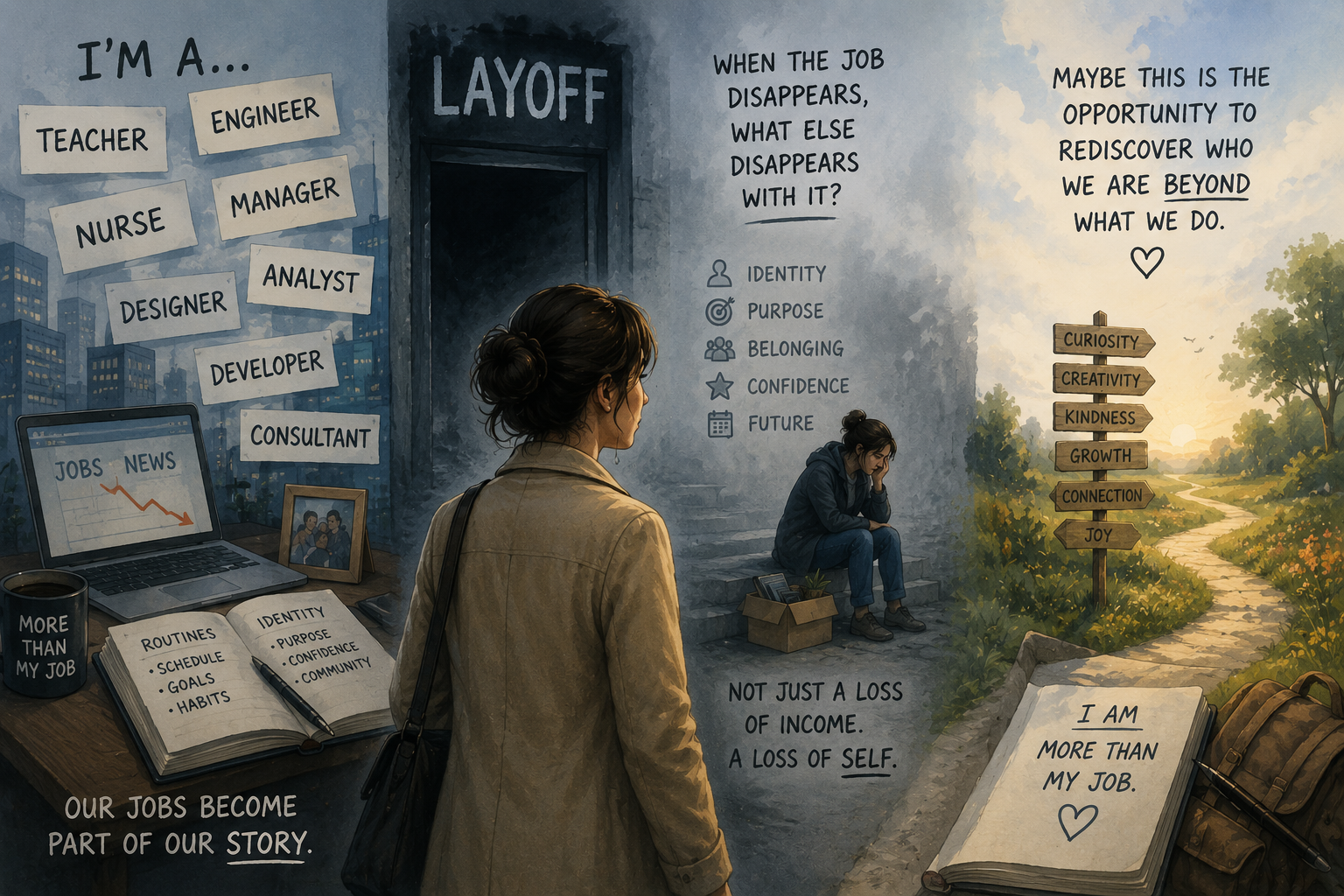
What happens when losing your job also means losing the identity you’ve spent years building?
The financial consequences are immediate, but for many people there’s another feeling that’s much harder to explain.
They don’t just feel unemployed.
They feel lost.
Why?
Why does losing a job feel so much bigger than losing a paycheck? Why can a job title become one of the first things we use to describe ourselves? And when that title disappears, what else disappears with it?
Think about how you introduce yourself to someone you’ve just met.
“I’m a teacher.”
“I’m an engineer.”
“I’m a nurse.”
Very few of us answer, “I’m curious,” or “I’m creative,” or “I’m someone who loves helping people.” Instead, we instinctively reach for our occupation because it’s one of the easiest ways to explain who we are. We rarely notice because everyone else does the same thing.
That doesn’t happen overnight.
Long before we earn a paycheck, we’re asked one of the first questions many of us remember: What do you want to be when you grow up? Students become future doctors, artists, engineers and teachers years before receiving their first paycheck. As adults, work shapes our routines, relationships and ideas of success. Little by little, what begins as something we do starts to feel like who we are.
Most of us never notice the shift because it happens so gradually. We introduce ourselves through our work for years until the connection between what we do and who we are no longer feels like a connection at all.
It simply feels true.
Then one day the role is gone.
Maybe that’s why unemployment can feel so deeply personal. Maybe that’s why retirement leaves some people wondering who they are without their careers. Maybe that’s why recent graduates who can’t find work begin questioning not just the job market, but themselves.
The economy didn’t create those feelings.
It exposed them.
We’ve built a culture where careers are more than a way to earn a living. They’re how we introduce ourselves, explain ourselves and often measure our own success. Without realizing it, many of us have spent years practicing an identity built around our occupation.
A layoff doesn’t just interrupt a career.
It can interrupt the story you’ve been telling yourself about who you are.
None of this makes the financial realities any less urgent. But what hurts isn’t only the loss of income. It’s also the loss of a role that had quietly become part of your identity.
The economy may have taken away the job, but it also exposed something that was there long before the layoff. Somewhere along the way, many of us learned to confuse what we do with who we are.
Maybe that’s another conversation worth having.
Leave a Reply