An empirical study on the social motivations of Twitch users
Introduction:
The gaming industry continues to grow in popularity and has evolved from arcade machines and personal gaming consoles to include massively multiplayer online (MMO) platforms. Through MMO’s millions of players can connect to compete or collaborate with one another. In recent years a third party has entered this sphere, the spectator. Spectatorship has become an increasing popular form of entertainment over the past decade. Millions of people attend professional esports gaming competitions every year1 and as a result have created a $134.9 billion-dollar global industry (Batchelor 2018). Online platforms such as YouTube and Twitch.tv have emerged for the sole purpose of fulfilling the need for spectatorship. Studies have been conducted to analyze the motivations of content streamers, (Johnson & Woodcock 2017; Netzorg, Arnett, Chaintreau, & Wu 2018) but what are the motivations and behaviors of the content viewers? It is common to have multiple streamers streaming the same content, i.e. playing the same video game or vlogging2 about the same topic.
Twitch.tv is an online streaming platform that brings millions of gamers and spectators together. Users are separated into two categories, streamers and viewers. Each streamer has their own channel which can be customized through Twitch’s widget interface. Some of these customization options include the ability to add an “About Me” section, chat log moderator controls, personalized emojis the streamer can gift viewers, and more. The “About Me” section tends to be the where streamers include personal information about themselves in order to attract or connect with viewers. Many streamers provide links to their personal social media accounts for viewers to follow and keep up with their favorite content creators (Sjöblom, Törhönen, Hamari, & Macey 2018). If channel customization is how streamers can differentiate between each other, does it have any impact over the viewers’ behavior? This study will attempt to answer the following research questions: are viewers more likely to subscribe to a streamer who provides access to their social media accounts and is there a relationship between the number of social media accounts a streamer links and the number of subscribers they have? These questions build upon the current literature exploring streamer/viewer engagements and how one side influences the other (Gandolfi 2016; Netzorg et al. 2018; Sjöblom et al. 2018). Viewer motivations have been categorized in terms of why they choose to watch others play video games instead of playing the video games themselves, (Gandolfi 2016; Sjöblom & Hamari 2016). Twitch provides a unique medium in which to study these practices because streamers are provided with the tools to customize their virtual space and utilize them at their discretion.
Literature Review:
Twitch streamer/viewer engagement has been studied by multiple disciplines including sociology, anthropology, computer science, and economics. A combination of qualitative and quantitative research has been presented to analyze the unique motivations and behaviors of streamers and viewers. Popularity studies have tried to explain why some content creators across multiple social media platforms are more popular than others. Social media users who have obtained the status of “influencer” by accumulating hundreds of thousands to millions of followers have some basic elements in common, like tagging their posts with broader themes such as #Nintendo instead of #ZeldaBreathoftheWild. By doing this the influencer is casting a wider net of interests in hopes of attracting more potential followers to their profile, (Netzorg et al. 2018). Social media users curate their content in order to increase their visibility and attract a bigger, more diverse audience, (Woodcock & Johnson 2019a).
Twitch streamers have picked up on these marketing trends and also curate their content according to the audience they want to attract. The relationship between streamer and viewer is dependent upon a number of factors. It has been suggested that viewers are drawn to particular Twitch channels by their own personal motivations. Sjöblom & Hamari (2016) classify these motivations into five categories: acquiring information or knowledge, emotional, pleasant, or aesthetic experience, enhancing creditability, enhancing personal connections with others, and tension release. The game genre or content type that a streamer chooses to broadcast have also been suggested to influence viewer behaviors. Viewers seeking information about a particular game will seek out streamers who are demonstrating that game and providing a relaxed virtual environment in which viewers can ask questions or discuss game strategies, (Sjöblom et al. 2017).
I have chosen to focus this study on the theme of social integration and personal connections. As individuals have become more alienated and isolated from their communities, virtual spaces are providing the sense of social solidarity that is missing in the real world, (Hornsby 2013). Twitch especially caters to the viewer searching for recognition by offering an interface embedded to every channel where viewers and streamers can chat in real time, (Nematzadeh, A., Ciampaglia, G. L., Ahn, Y. Y., & Flammini, A. 2016). The chat log gives the practice of video game spectatorship an element of intimacy between the streamer and viewers, (Taylor 2016). In one sample group Sjöblom & Hamari (2016) suggested the emergence of a relationship between personal integrative motivations and the number of hours watched by the viewers, but no relationship could be determined between personal integrative motivations and the number of channels a viewer is subscribed to. I will test those quantitative relationship measures from the perspective of the streamer instead of the viewer to see if the statistical data suggests a theme in viewer motivations.
Twitch streamers have a number of tools available to them from the Twitch platform which they can use to create a channel that reflects their motivations for streaming. One major motivation for streaming content is profit. The business of live streaming has become so popular that the distinction between professional and hobbyist is not always clear, (Johnson & Woodcock 2019b). There is a trend among the most popular channels, in terms of the number of subscribers, to include a combination of “ingredients” (Sjöblom et al. 2019) that meet the requirements for Sjöblom & Hamari’s (2016) suggested five categories of viewer motivations. The higher the subscriber count the more visibility that channel receives, and its earning potential is increased. Providing social media access links is a customization option that appears consistently among the most popular Twitch channels. This study focuses on social media links instead of other “ingredients” because as streamers develop a virtual community, access to their social media profiles encourages a sense of familiarity between themselves and viewers that is important to social integration motivations. I suggest that there is a statistically significant relationship between the number of social media links provided on a Twitch channel and the number of subscribers that channel has acquired.
Sample, Methodology, & Analysis:
The sample for this study consists of 111 Twitch streamers that are ranked highest just in terms of total subscribers, as determined by a third-party analytics website. Streamer subscriber data used in this study was gathered from the third-party Twitch statistics and analytics website, SulleyGnome. This data sampling was chosen for this study to provide better insight into the channel customization trends of “successful” (Johnson & Woodcock, 2019b) Twitch streamers. Streamer data is updated daily to provide users with accurate and valid information. All data examined during the course of this study is up to date as of October 13, 2019.
Twitch streamers are defined as individuals (including all genders, races, ethnic groups, ages, and other defining demographics) not associated with professional gaming organizations, that have an active Twitch account, meaning content has been streamed within the past 30 days. Social media links are limited to the following platforms in no particular order: YouTube, Instagram, Facebook, Twitter, Discord, Snapchat, and personal websites including blogs. In order to support my hypothesis that there is a statistically significant relationship between the number of social media links provided on a Twitch channel and the number of subscribers that channel has acquired, I have chosen to omit Twitch channels that are operated by organizations from the sample data. For example, Blizzard Entertainment3 operates a Twitch channel to promote products and services provided by their company. In order to analyze the motivations and behaviors of viewers seeking social integration and personal connections, the sample data must be limited to channels operated by individuals, n = 111.
The 111 Twitch channels included in this study are ranked by the total number of subscribers, acting as the dependent variable, ranging from 803,554 to 7,000,846. Each streamer’s subscriber count is unique, there are not multiple subjects with the same number. The dependent variable is measures as an interval variable. The total number of social media links provided on each streamer’s channel is acting as the independent variable. The independent variable is displayed on a scale from 0 to 7, with each social media link accounting for (1). The independent variables are measured as interval/ratio and absolute zero is a valid response on the independent variable scale. The type of social media profile linked is not taken into consideration in this study’s results, but further research could be conducted to examine the influence each, or a combination of the seven, has on the dependent variable.
The data collected is analyzed using quantitative measures. Frequencies on all independent and dependent variables gives an overall snapshot of the data distribution and where there might be concerns during further testing. Frequencies allow us to identify outliers, possible errors in measurement, or a heavy-tailed distribution within the population.
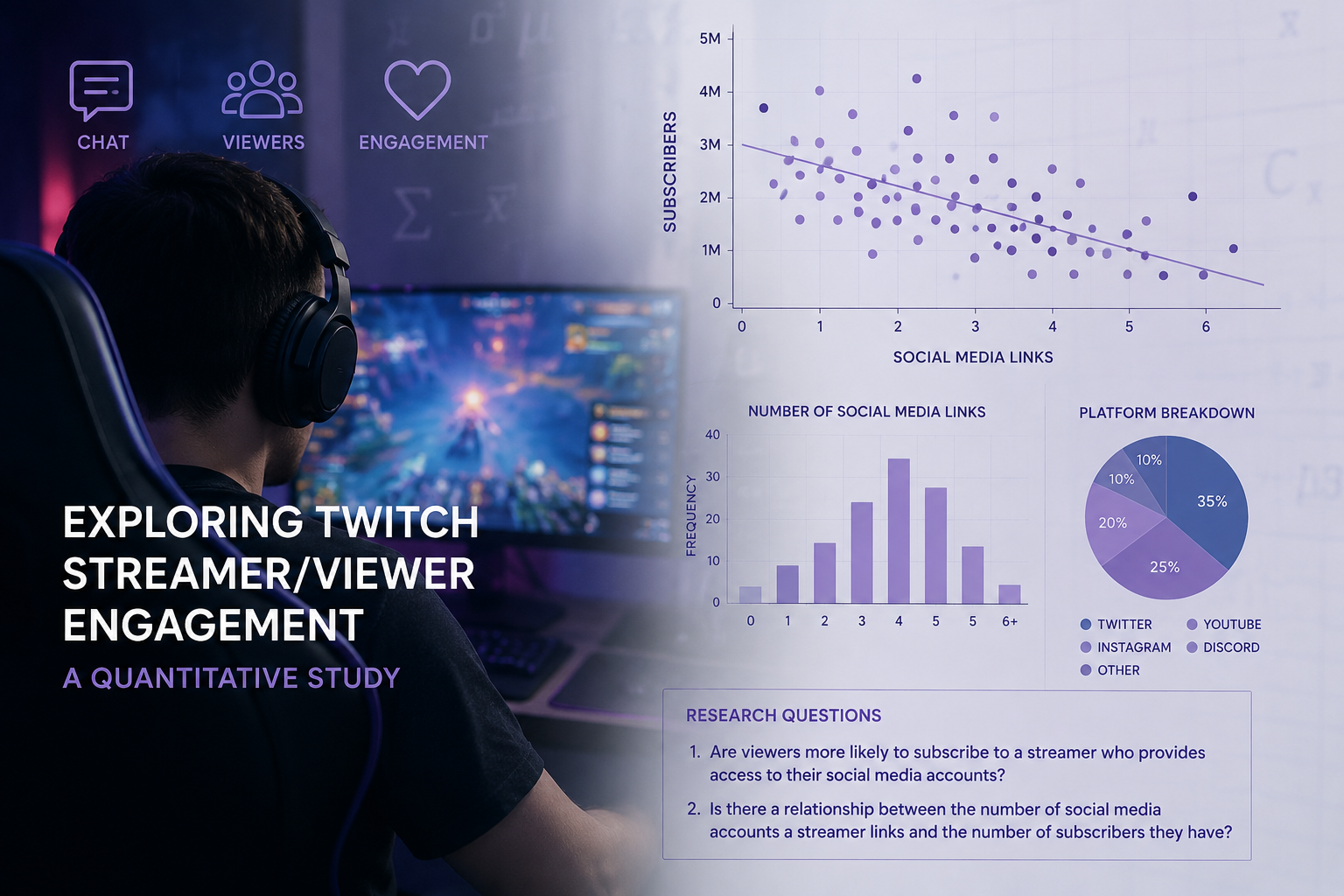
Of the 111 streamers included in this study, table 1.1 displays the frequencies of the total number of social media profiles linked on the sample’s channels: 0=1, 1=5, 2=8, 3=27, 4=35, 5=23, 6=11, 7=1. The outliers included on this scale, (0) and (7), have been preserved in the data because while they appear to be abnormal within this selected population of Twitch streamers, they are common across the entire Twitch streamer population. They are also identified as mild outliers, worth keeping within the sample, because the difference between their frequencies and the next closest in less than 5 degrees.
After verifying frequency measures to ensure there are no errors in the variable datasets, Pearson’s correlation coefficient will be used to assess the direction and strength of the relationship between the independent and dependent variables. Pearson’s correlation coefficient is an appropriate test for the selected variables, as they are both interval and perfectly, positively correlated on their own as represented by the “1” in each correlation rating (see table 3.1). I hypothesize that the correlation between the number of social media profiles linked on a streamer’s channel and the number of subscribers a streamer has is not equal to zero in the population. In order to determine if there is a statistically significant relationship between the independent and dependent variables, the alpha level has been set to 0.05 for the purposes of this study.
A bivariate linear regression test is performed to assess the predictive or explanatory relationship between the independent variable (number of social media profiles linked on a streamer’s channel) and the dependent variable (a streamer’s total number of subscribers). This test is relevant to the hypotheses and is appropriate to interpret as the p = 0.02 < alpha = 0.05. A regression test can suggest the degree in which the number of social media links on a streamer’s channel influences the number of subscribers.
Results:
This study investigates the relationship between the number of social media profiles a Twitch streamer links on their channel and the number of subscribers a streamer has in pursuit of answering the following research questions: are viewers more likely to subscribe to a streamer who provides access to their social media accounts and is there a relationship between the number of social media accounts a streamer links and the number of subscribers they have? Based on these research questions I offer the following hypotheses: there is a statistically significant relationship between the number of social media links provided on a Twitch channel and the number of subscribers that channel has acquired and as the number of social media links on s streamer’s channel increases the number of subscribers increases as well. The alpha level for this study has been set at 0.05 to determine if relationships are statistically significant.
Frequency tables 1.1 (available on separate pages) and 1.2 provide the datasets of the independent and dependent variables. Table 1.2 displays two outliers within the dataset at (0) and (7). These outliers are included in the tests and results in order to provide an accurate description of the greater Twitch streamer population. There are no missing values in the independent or dependent variables. Table 1.2 provides the frequency results for the number of social media profiles linked on a streamer’s channel in the sample population. The majority of the sample (31.5%) provide 4 social media links, followed by in descending order, 24.3% providing 3, 20.7% providing 5, 9.9% providing 6, 7.2% providing 2, 4.5% providing 1, and tied at 0.9% are 0 and 7. A scatterplot, graph 1.3, is also provided for a visual representation of the frequency distribution. The IV is on the X axis and the DV is on the Y axis. As the IV increases across the X axis, the DV increases as well on the Y axis, until the mean is reached between 3 and 4. Beyond the mean the DV begins to decrease as the IV continues to increase. Graph 1.3 displays a normal distribution.
Table 1.2
Frequency TOTAL (IV)

Graph 1.3

The independent and dependent variables are measured as continuous linear variables and as such a mean can be calculated from each, as seen in Means table 2.1. The average total of social media links provided by the sample is 3.8739, rounded up to 4 for the purposes of this study. The average number of subscribers the sample has is 1,619,123.08, rounded down to 1,619,123. With over 1.5 million subscribers as the average for this sample, each streamer would fall into the “successful” (Johnson & Woodcock 2019b) category referred to in the sample section. The TOTAL mean (4) in table 2.1 will be used as the constant which other values are compared to in the regression tests.
Table 2.1
Means Table

Pearson’s correlation coefficient is represented by table 3.1. This statistical model tests both hypotheses stated previously. There is evidence to support the hypothesis that the number of social media links a streamer includes on their channel and the number of subscribers is correlated. Since the chosen alpha value (0.05) is greater than the p-value (0.02), I reject the null and it is appropriate to interpret the Pearson’s correlation coefficient. The r = -0.221 suggesting that there is a weak, negative relationship between the IV and DV.
Table 3.1
Pearson’s correlation coefficient

The linear regression test is represented by tables 4.1, 4.2, and 4.3. The regression models are appropriate to interpret as the p = 0.02 < alpha = 0.05, suggesting there is a statistically significant relationship between the number of social media links a streamer includes on their channel and the number of subscribers. According to table 4.1, r = 0.221, suggesting there is a weak, positive relationship between the IV and DV. R2 = 0.049 to show the proportion of the dependent variable that is explained by the independent variable.
The constant used in table 4.3 is the average number of social media links streamers provide on their channel (4) within the sample population. On average, streamers who link 4 social media profiles on their channel have approximately 1,595,728.03 subscribers. Each additional link provided on a streamer’s channel statistically significantly influences the number of subscribers by approximately -185,489.36. This study only includes one dependent variable and one independent variable, but future research could be conducted to include additional independent variables to further test this significance finding. Independent variables such as streamer gender, average views, or broadcasted game genres could give insight into other factors that influence the number of subscribers. Viewer motivations and behaviors are complex and can be influenced by a combination of elements, as such I would suggest continuing this quantitative study to include additional variables.
Table 4.1

Table 4.2

Table 4.3

Conclusion:
Streamer/viewer engagements, motivation, and behaviors are found to be influenced by many factors including but not limited to social integration, profit, entertainment, channel customization, community, etc. (Gandolfi 2016; Netzorg et al. 2018; Sjöblom et al. 2018). Multiple studies have attempted to identify these factors and explain the relationships between them. This study builds upon current viewer/streamer engagement studies by asking, are viewers more likely to subscribe to a streamer who provides access to their social media accounts and is there a relationship between the number of social media accounts a streamer links and the number of subscribers they have? This study shows that there is a statistically significant relationship between the number of social media accounts a streamer links on their channel and the number of subscribers they have. The statistical testing completed during this study, Pearson’s correlation coefficient and regression models, determine this relationship to be weak (0.221).
Although this particular relationship appears to be weak, this study can be used as a starting point for future research to include different variables, sample groups, or motivations to analyze. As discussed previously, not one element can be attributed to the explanation of viewer/stream engagement motivation and behaviors. This study only focused on social integration motivations of individuals through the use of two variables. I would suggest future studies to expand these variables to include elements from Sjöblom and Hamari’s (2016) five categories. A control variable, such as gender, could also be applied to the sample group to determine if there is a statistically significant relationship between male and female streamers and their subscribers.
It is important to remember that correlation does not explain causation. The results of this study are not strong enough to identify the cause behind the number of subscribers a streamer has. The frequency tables do suggest an empirical association between the IV and DV, as we see that as one variable increases the other increases or decreases at the same time. Time order cannot be verified through this study as we cannot verify if the variation of the IV came before the variation of the DV. This study is also unable to prove nonspuriousness between the variables as they are limited and we cannot be for sure that the influences upon one another are not actually due to a third, nonidentified variable. It is safe to suggest that there might be a relationship between the number of social media accounts a streamer links on their channel and the number of subscribers they have, but I would not determine an explanation beyond that.
The methods used in this study are not limited to Twitch, they could be applied to other online platforms where there is an element of content creator and content consumer engagements. Virtual spaces and online communities continue to grow in number and popularity, encouraging researchers across many disciplines to attempt to explain the human trends within these environments. This study is one of many that presents just a small piece of the large puzzle.
References:
About Blizzard. (n.d.). Retrieved December 3, 2019. (https://www.blizzard.com/en-us/company/about/).
Batchelor, J. 2018. “Global Games Market Value Rising to $134.9bn in 2018.” GamesIndustry.biz. Retrieved December 3, 2019. (https://www.gamesindustry.biz/articles/2018-12-18-global-games-market-value-rose-to-usd134-9bn-in-2018).
Gandolfi, Enrico. 2016. “To watch or to play, it is in the game: The game culture on Twitch.tv among performers, plays and audiences”. Journal of Gaming & Virtual Worlds. 8(3):63-82.
Hornsby, A. 2013. “Surfing the net for community: a durkheimian analysis of electronic gatherings”. Illuminating social life: Classical and contemporary theory revisited. Thousand M.Oaks, CA: SAGE Publications, Inc.
Johnson, Mark R., Woodcock, Jamie. 2019a. “Live Streamers on Twitch.tv as Social Media Influencers: Chances and Challenges for Strategic Communication”. International Journal of Strategic Communication. 13(4):321-335
Johnson, Mark R., Woodcock, Jamie. 2019b. “’It’s like the gold rush’: the lives and careers of professional video game streamers on Twitch.tv”. Information, Communication & Society. 22(3):336-351
Nematzadeh, A., Ciampaglia, G. L., Ahn, Y. Y., & Flammini, A. 2016. Information overload in group communication: From conversation to cacophony in the Twitch chat. arXiv 1610(1).
Netzorg, R., Arnett, L., Chaintreau, A., and Wu, E. 2018. “PopFactor: Live-Streamer Behavior and Popularity. International Journal of Strategic Communication. arXiv 1812(1).
Sjoblom, M., Torhonen, M., Hamari, J., and Macey, J. 2018. “The ingredients of Twitch streaming: Affordances of game streams”. Computers in Human Behavior 92:20-25.
Sjoblom, M., Torhonen, M., Hamari, J., and Macey, J. 2017. “Content structure is king: An empirical study on gratifications, game genres and content type on Twitch”. Computers in Human Behavior 73:161-171.
Sjoblom, M. and Hamari, J. 2016. “Why do people watch others play video games? An empirical study on the motivations of Twitch users”. Computers in Human Behavior 75:985-996.
Taylor, N. 2016. “Now you’re playing with audience power: The work of watching games”. Critical Studies in Media Communication, 33(4):293-307.
Leave a Reply